Hometransalt.org

Brooklyn Bridge Bike/Pedestrian Access:
Brooklyn Side

March 2, 1999

The "chute" to Adams-Tillary ends at a dangerous, poorly-designed intersection where ped/bike/car collisions and injuries are frequent.

Read the latest news about this issue.

At the T.A. Brooklyn Committee meeting on 2 March 1999, a presentation was given on the status of improvements to bike and pedestrian access to the Brooklyn side of the Brooklyn Bridge. The presenter was Tom van den Bout, an architect who is associated with the firm of Konheim and Ketcham (K&K). K&K have been heavily involved in designing improvements to access to the Brooklyn Bridge in both Brooklyn and Manhattan. The focus of this presentation was improvements on the Brooklyn side of the bridge.

The planned improvements are interrelated and are as follows:

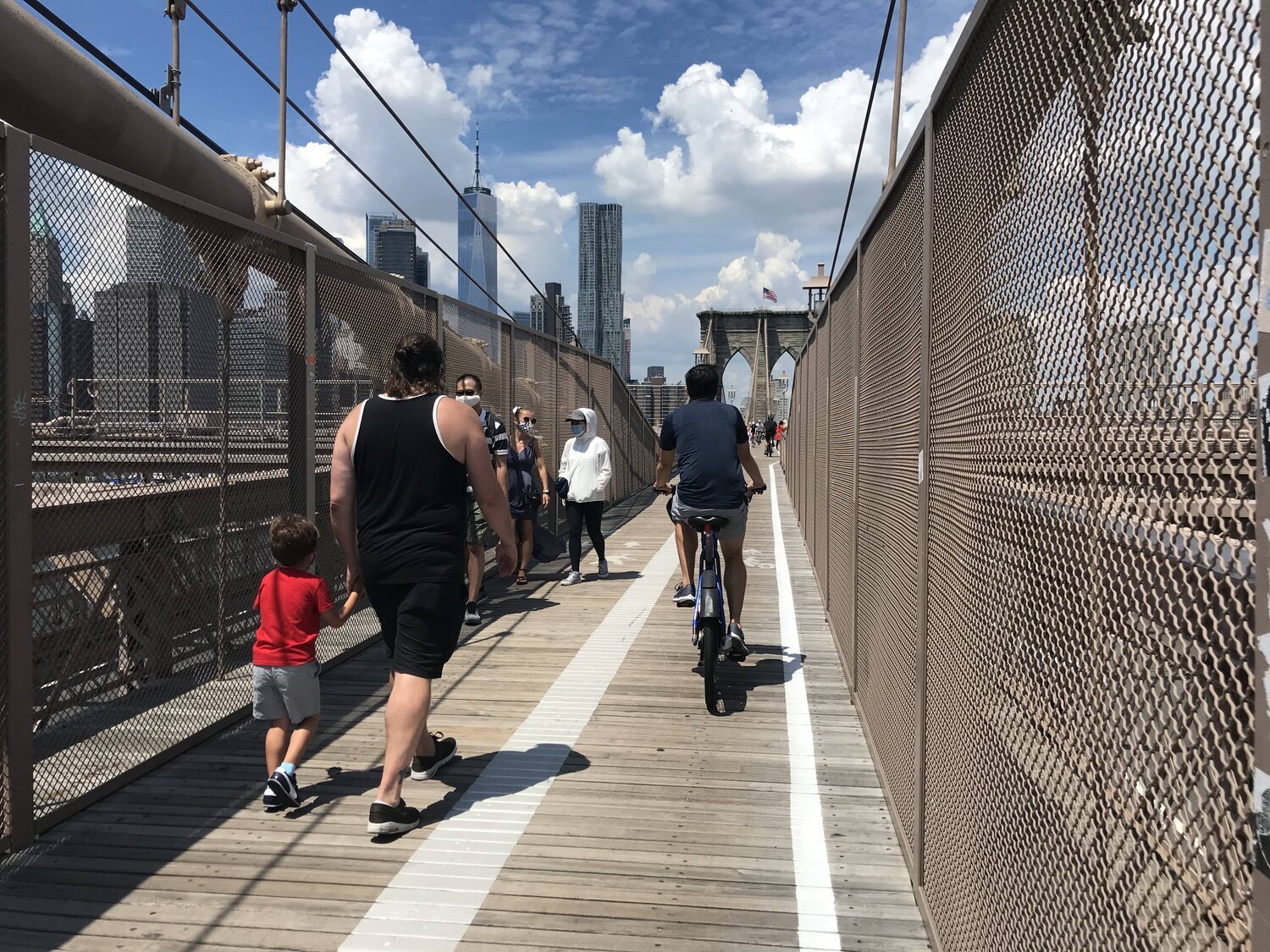
  1. Access to/from Brooklyn Bridge footpath. At present there are two outlets from the Brooklyn Bridge footpath into Brooklyn: the stairs going down to Cadman Plaza East, and the ramp going between the Manhattan-bound and Brooklyn-bound roadways of the bridge to the intersection of Adams and Tillary Streets. The stairs are difficult to find from street level, and while the stairs are now well-lit, the entrance is beneath a highway overpass that is not well lit. The "chute" to Adams-Tillary is narrow and there is heavy competition with vehicular traffic at that busy intersection. The plan that was presented calls for a new ramp to be built, starting approximately where the wood-plank surface of the footpath changes to a concrete surface. The new ramp would be set at a more level gradient than the present ramp and would thus rise above the roadways to where it could cross over them at a safe height. The plan calls for a new set of stairs to go from the new ramp across the Manhattan-bound roadway and then down to Washington Street (the continuation of Cadman Plaza East), with the ramp crossing the Brooklyn-bound roadway and descending to Cadman Plaza East. The existing stairs to Washington Street and "chute" to Adams-Tillary would be closed.

  2. Improvements to Walt Whitman Park. The plan calls for a redesign of Walt Whitman Park (the park area between Cadman Plaza East and Cadman Plaza West) to take into account not only the proposed ramp from the Brooklyn Bridge footpath, but to make the park more inviting and a destination in itself. This would be done by changing the layout of the north end of the park, installing a concession area, and other improvements. A major proposed change is the de-mapping of Cadman Plaza East from Johnson Street (at the south end of the General Post Office) to Prospect Street (just north of the Brooklyn Bridge overpass). De-mapping means that Cadman Plaza East would no longer be a street. Cadman Plaza East is very lightly used except as parking for judges and others with business in the U.S. Court House and General Post Office. The proposal calls for the de-mapped area to become part of the park, as a landscaped bike and pedestrian mall that would afford a through route from the Dumbo area (between the Brooklyn and Manhattan Bridges) to Borough Hall.
  3. A pedestrian overpass over the Brooklyn Bridge approach, linking Concord Village (the apartment complex north of Tillary Street and east of the approach) with the redesigned Walt Whitman Park. This would give residents of Concord Village easier and safer access to Borough Hall and Brooklyn Heights than is now possible by having to cross at Adams-Tillary.
Click here to see a diagram of the plan.

According to Mr. van den Bout, this plan has been endorsed by the Brooklyn Borough President, the New York City Department of Transportation, the City Planning Commission, and the Brooklyn Heights Association. Brooklyn Community Board No. 2, the New York City Department of Parks and Recreation, and Concord Village are not yet "on board." Still to be approached are civic and business groups such as the Brooklyn Chamber of Commerce.

The benefits of the full plan are as follows:

  1. Reduction of competition between motorized traffic and non-motorized traffic (pedestrians and bicycles) at Adams-Tillary. This is a very busy and dangerous intersection, and a workable plan to reduce the amount of non-motorized traffic will increase safety.
  2. Increased use of Walt Whitman Park. By bringing more bicycle and pedestrian traffic into the park, concessions such as cafes will be viable. The park will also be a gateway to Brooklyn Heights and Downtown Brooklyn for residents and tourists alike.
  3. A greater sense of connectedness between Concord Village and Brooklyn Heights. The isolation afforded by Tillary Street and the Brooklyn Bridge approach is unfortunate. Improved access from Concord Village would give its residents safe access to Walt Whitman Park and Brooklyn Heights.

During the 2 March meeting, questions were raised as to how bicyclists could continue to Park Slope and beyond if the plan were implemented, considering that bicycles are not allowed on the plaza in front of Borough Hall. Taking the new ramp down from the Brooklyn Bridge, cyclists could proceed along the Cadman Plaza East mall to Tillary Street, then head west to Henry Street and then south through Cobble Hill, or could turn left at Johnson Street (at the south end of the General Post Office), then 1 block to the southbound local roadway of Adams Street.

Read the latest news about this issue.

Brooklyn Committee Home Page
Bridges Main Page
Prospect Park

© 1997-2008 Transportation Alternatives
127 West 26th Street, Suite 1002
New York, NY 10001