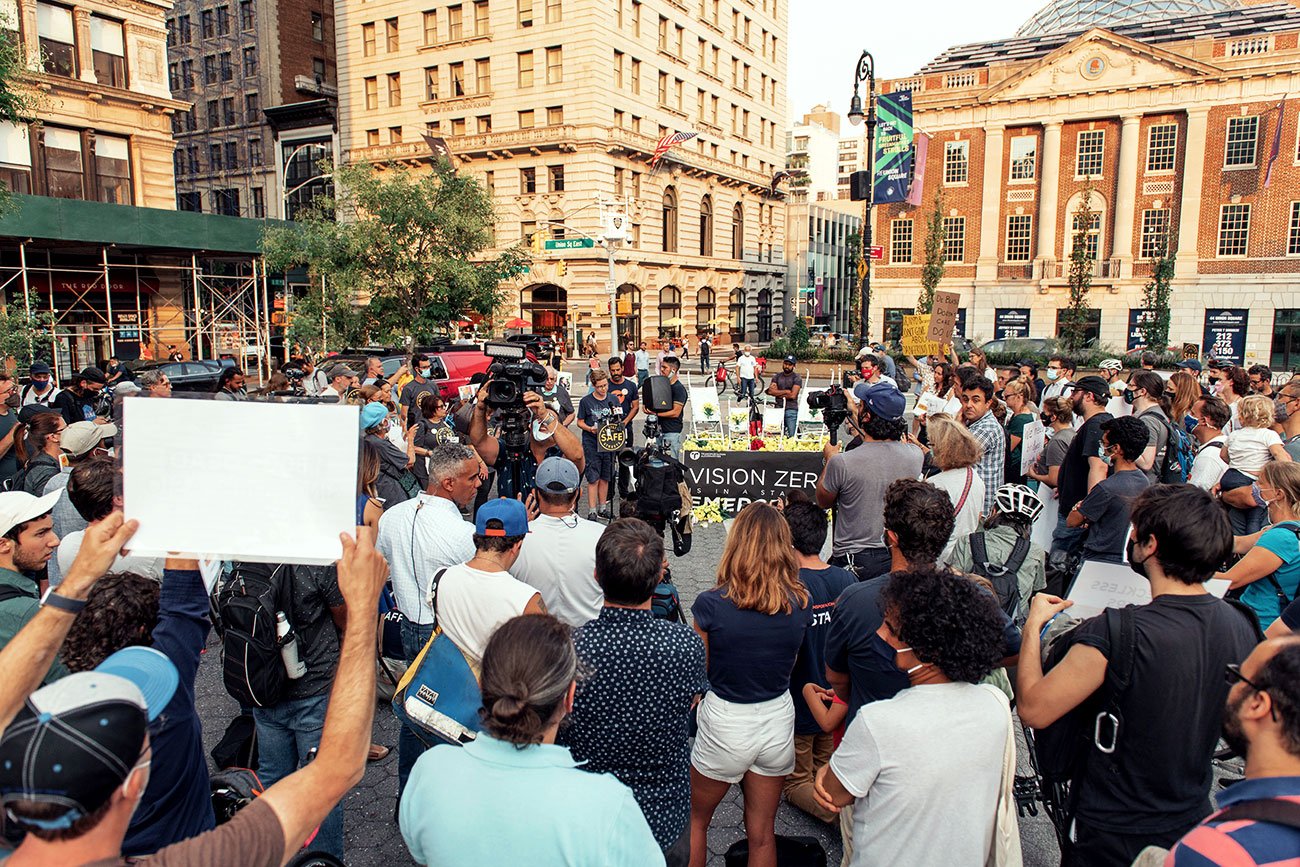
Cycling Deaths Soar to Historic High in 1999From T.A. Magazine, March/April 2000 In late December 1999, the cycling world was stunned to learn that cycling deaths nearly doubled in 1999. A record 35 NYC bicyclists were killed. Compare this to 18 deaths in 1998, and the previous high of 24 deaths in 1985. The toll was such a surprise because of reporting delays from the police, and because the first six months of the year included only an average number of cycling fatalities. T.A. reacted swiftly to the horrible news by orchestrating extensive press coverage and conducting a well attended, January 9th, vigil at City Hall. The event included eloquent statements by many cyclists and featured 35 cyclists in repose with their bikes: a dramatic reminder of the magnitude of the previous year’s tragedy. T.A.’s vigil, and the enormous press coverage it generated, prompted the mayor to pledge a crackdown on aggressive drivers at his state of the city address two days later. Mayor Pledges ActionThe mayor’s address made it completely clear that the police crackdown on aggressive drivers was intended to make cyclists and pedestrians safer. The mayor said “Obviously we have too many people driving aggressively in the City of New York. We need an aggressive driving program.” The mayor also noted that the decrease in drunk driving fatalities came about “...because of policy policy that caused people to change their behavior, and in the process saved lives.” The mayor added, “So we’re going to dedicate specific patrol cars to this effort. 25 of them will be outfitted with two cameras. We’re going to focus on areas in the City that have seen the most accidents.” The mayor then ordered the cars of aggressive drivers be seized, adding “That’s a serious penalty for a serious crime. It’ll remind people that driving is a privilege, and that when you exercise that privilege, you have the responsibility to do it safely.”
Where is the Crackdown on Aggressive Drivers?The mayor’s remarks were encouraging to beleaguered cyclists — especially his unambiguous assertion that the problem was dangerous driving and that he was going to do something about it. Unfortunately, so far, the police department has done nothing to prevent a repeat of last year’s cycling catastrophe. According to police sources, the 25 camera-equipped patrol cars assigned to stopping aggressive driving are spending all of their time on area highways — not the city streets where cyclists and pedestrians are dying. Remarkably, police officials say the aggressive driving program, with its video camera cars, is tailored for highway enforcement only. Thus, the mayor’s strong words have translated into absolutely no concrete action by the police or any other City agency. Cops Blame VictimsPrior to the mayor’s remarks, police officials told the press that cyclists were to blame for their own deaths in 70% of the cases. The cops claimed that careful crash investigations revealed this fact. T.A. has filed a Freedom of Information request to see what these reports say. We are skeptical of police crash investigation methods. Motorists caused three of the fatal cycling crashes that we have detailed knowledge of. An extensive analysis of five years of NYC pedestrian and cycling fatalities by the group Right of Way found motorists partially or completely responsible in 74% of bike and pedestrian fatalities, and partially at fault in 90%. Other national studies suggest that motorists are at fault in 70% of cycling fatalities — the opposite of the NYPD’s conclusion here. It is becoming apparent that the way the police conduct crash investigations leaves much to be desired. NYC would be well served by adopting the “coroner’s inquest” system used by Toronto. There, every cycling and pedestrian fatality is investigated by the coroner’s office the same way that murders are. This would inject an objective, public health perspective into a police culture which assumes that cyclists either kill themselves or die by “accident.” Of course, looming above all is the much bigger cultural and legal problem that motorists who kill and maim almost always go unpunished. Ironically, the logic of the police “blame the victim” approach assumes a huge increase in the number of cyclists. This assumption is not supported by DOT cycle counts which show a slight decline in everyday cycling. The police stance that cyclists are killing themselves is very dangerous. It is an excuse not to increase or change police traffic enforcement strategies. Instead, the cops reason that safety education for cyclists is the answer. Along these lines, police officials have reached out to T.A. for ideas on how to reach out to cyclists. Who Died?We only know the names and stories of a few of those killed, otherwise we would share them here. But, thanks to the group Right of Way and T.A. research, we do know some things. Thirty two of the cyclists killed were men, and the median age of the victims is 38. This said, the cyclists killed belied the common NYC stereotype of daredevil, young bike messengers. Five of the cyclists were killed in Manhattan south of 60th street, where messengers are concentrated, and only one in Manhattan north of 60th where complaints about food delivery cyclists are concentrated.
T.A.s RecommendationsIn a January 21 letter to the police and the mayor’s office, T.A urged a comprehensive enforcement and education plan for both motorists and bicyclists. Including:
ConclusionMaking streets safe for cyclists will require a combination of enforcement, engineering and education. That means things like cops busting dangerous drivers, well designed bike lanes, paths and bridge entrances, and a comprehensive education campaign using TV, radio, print and billboard advertising to inform both motorists and cyclists. We have focused here on police traffic enforcement, because that is what Mayor Giuliani offered as his immediate response to the problem. T.A. agrees with the mayor that vigorous enforcement can have a big effect on how motorist’s behave. The short term challenge for T.A. is to ensure the police act, and that they face the mayor’s wrath if they do not. And, if the mayor won’t honor his pledge? It is an election year.
© 1997-2009 Transportation Alternatives |
||||||||||||||||||||||||||||