Midtown Pedestrian Action To Clear The Barricades

December 29, 1998
Noon, Tuesday, December 29, 1997
5th Ave. and 50th Street (North East Corner)

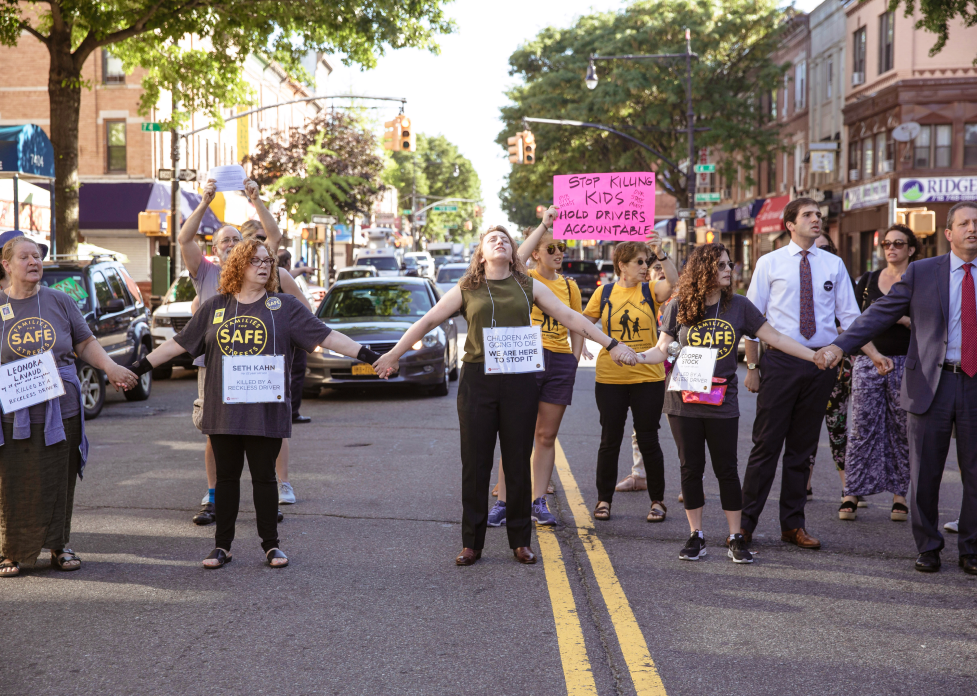
Pedestrians will gather to demand the Mayor abolish pedestrian barricades in Midtown and improve conditions for pedestrians on crowded Midtown sidewalks. Some participants will dress as cattle and travel as a herd around the intersection of 5th and 50th to dramatize the mistreatment of pedestrians. Other participants will carry signs saying:

"Foot traffic is good traffic," "Pedestrians are not cattle," and "Remooove the barricades." A banner saying "Cars are anti-city" will be in the background.

"Walkers are not cattle, there to be barricaded, herded and pushed around for the convenience of motor vehicle traffic. There are too many automobiles, not too many pedestrians in Midtown. " Said John Kaehny, Executive Director of Transportation Alternatives, New York's pedestrian advocates. "We challenge the Mayor to tackle traffic head-on by making 49th and 50th Streets pedestrian and bus only streets. At the least, the barricades should be permanently removed and the sidewalks widened at the very intersections that are now barricaded. Lastly, experienced experts at the Department's of Transportation and City Planning - not the police - should be making key transportation decisions.

Comprehensive studies have recommended giving pedestrians more space and time to travel - not less.

The 1995 Midtown Mobility Task Force, Co-Chaired by Con Edison CEO Eugene McGrath and then DOT Commissioner Elliot Sander with the participation of numerous business, civic and transportation leaders, found that the 49th and 50th Street bus ways were hampered by drivers disobeying rules and double parking. The Task Force recommended that motor vehicle enforcement be increased, new signs installed and load-unload rules enforced on 49th and 50th Streets. It also suggested pedestrian leading times - pedestrians getting an additional 5 seconds to cross before motor vehicles - and shorter traffic signal cycles. The group did not recommend pedestrian barricades.

A 1982 Department of City Planning Study, Pedestrianspace which resulted in the creation of the 49th and 50th Street bus ways, and recommended widening and extending sidewalks at corners to discourage through motor vehicle traffic and accommodate the additional pedestrian traffic produced by the bus routes. This was not done, and today these are the exact corners that the Giuliani administration has erected barriers on.

MIDTOWN PEDESTRIAN BARRIERS

Why they don't work

The New York Police Department is not in the business of transportation planning. NYPD designed the pedestrian barrier policy without consulting the City's traffic experts, at the Department of Transportation. It's strictly cocktail napkin stuff -- devoid of comprehensive transportation analysis.

The barriers will do little to relieve congestion. Currently, midtown traffic crawls along on average at 6.2 mph. During optimum conditions, the maximum speed in midtown traveling east to west is 10.5 mph. This is due to signal timing and long blocks, not pedestrian traffic. Treating pedestrians like cattle in one of the world's premier pedestrian districts in an poorly though out attempt to increase vehicle speed is disgraceful. Other cities, Paris, London and Tokyo have "pedestrian only" zones or prohibit left-hand turns on streets with high pedestrian volumes.

Delayed pedestrians translate into economic loss. According to a traffic engineer close to the issue, "On average there are 500 hundred cars and 7000 pedestrian per hour at each midtown intersections. For every minute saved by motorists in midtown, tack on ten minutes to the average pedestrian trip." This translates into a daily saving of 48 hours for motorists but a loss of nearly 7200 hours for pedestrians. In terms of economic outputs, that's a loss of nearly one year.

What will work

Solutions to congestion abound right here in the Big Apple. Lower Manhattan and Downtown Brooklyn, the second and third largest business districts respectively in NYC, are looking at pedestrian enhancements like wider sidewalks to promote walking and reduce traffic. In 1995 a blue ribbon panel of business people, transportation experts, and civic leaders convened the Midtown Mobility Task Force. This group came up with numerous innovative solutions which should be revisited.

Midtown Mobility Task Force Recommendations

  • Taxi stops only at corners.
  • Congestion pricing for parking in which peak hour rates are higher.
  • Strict enforcement of loading/unloading commercial zones.
  • Strict enforcement of double parking.
  • Widen sidewalks at intersections.

Submitted by forrest on January 31, 2008 - 14:16. categories [ ]